Side A
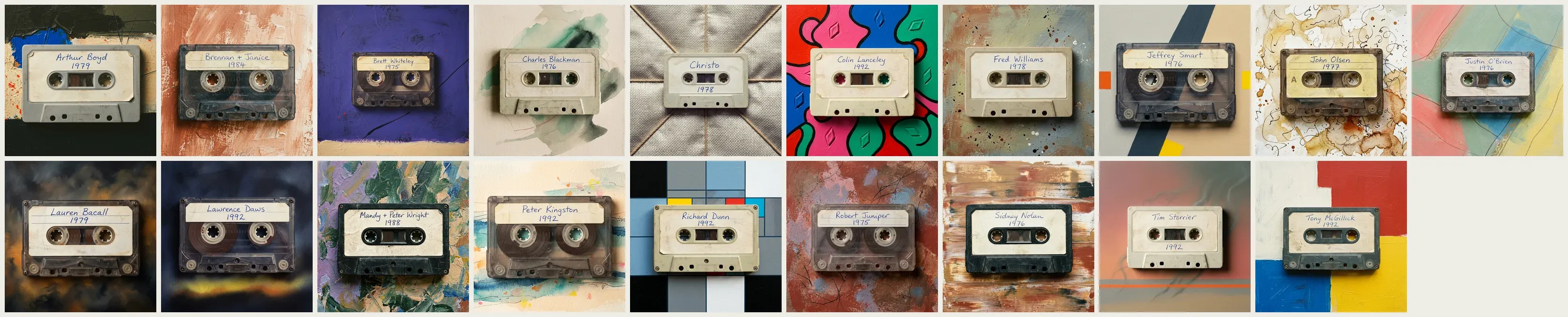
For three decades, a stack of unlabelled cassette tapes sat on a shelf. On them: nearly thirty hours of raw conversation with the defining figures of Australian art’s boom years. The questions belong to my mother, the art critic Sandra McGrath. The answers belong to Brett Whiteley, Arthur Boyd, John Olsen, Tim Storrier — and, from 1979, Lauren Bacall. Further along the shelf: Sidney Nolan, Charles Blackman, Fred Williams, Justin O’Brien, Christo.
My mother was an Alabama-born Vassar graduate who ran a gallery on San Francisco’s Jackson Square before she married an Australian and moved to Sydney in 1959. Over the next three decades she worked at the centre of Australian art’s boom years. She wrote for Art and Australia from 1966, served as art critic of The Australian from 1972 and the Sydney Morning Herald from 1987, and sat on the International Council of New York’s Museum of Modern Art. She was the kind of critic who would fly to Tuscany to talk Jeffrey Smart into joining Australian Galleries. One art historian later called her a kingmaker.
But the writing was only half of it; our house was the rest. The dining room at Bellevue Hill was painted wall to wall with a Jeffrey Smart landscape. Boyd, Whiteley, Olsen and Storrier moved through that room, and through Bundanon, the property she and my father owned with the dealer Frank McDonald until Arthur and Yvonne Boyd bought it from them in 1979.
When my mother sat down to interview these artists, there was no ice to break. She was interviewing Boyd about the Shoalhaven as the previous owner of his stretch of it. When she interviewed Whiteley, it was with a man she had known since the early sixties; on the night Whitlam was elected, they drove through town in his jeep, hammering the horn.
You can hear this intimacy on the tapes. They are working recordings, never tidied for broadcast. The 1979 Arthur Boyd tape opens mid-task: the two of them sorting photographs of his Shoalhaven paintings into piles for The Artist and the River. Some of the photographs have no titles on them, and my mother wants to keep it that way:
Arthur Boyd: What did you put the ones without a name on them?
Sandra McGrath: I don’t want to put a name on them, so I can look at the pictures without… the tag will cover them up.
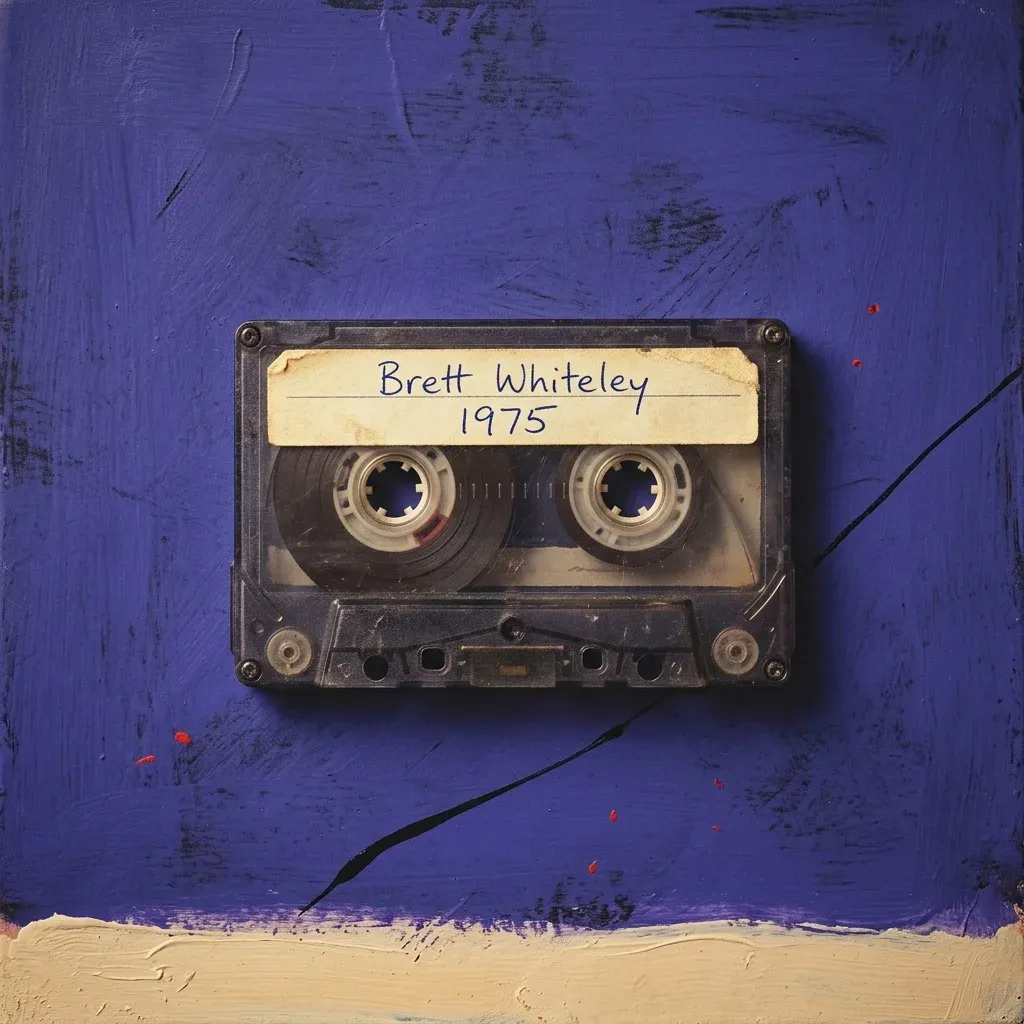
The tapes catch artists in the act of deciding things. The Whiteley sides, recorded in 1975 and 1976 while she was writing his 1979 monograph, find him mid-decision, announcing that the apprenticeship is over:
Brett Whiteley: …to go out into nature… to just go out like Vincent, you know, every day with one canvas and come in at night, and you’ve either got it or you haven’t.
Later on the same tape, Frank McDonald drops by, pulling out a book of D. H. Lawrence’s landscapes to compare them with Whiteley’s trees. Whiteley’s verdict on Lawrence as a painter is on the tape.
Because they are raw, the ambient life of the interviews bleeds through. On the Tim Storrier sides, an argument about realism crashes into the day’s other business:
Tim Storrier: Well, there’s a there’s a fundamental dumbness about realism per se —
Waiter: Would you like to order, or shall we leave you a few moments?
The lamb casserole gets the same air time as the argument. At one point my mother says “I’m turning it off, actually,” and the transcript carries on regardless. A print interview throws all of this away, but the tape keeps the hesitations, the retractions, the artist telling her a joke and then telling her to leave it out. You can hear the books being made.
The recordings from 1992 are something else entirely. Brett Whiteley died that June, and my mother went back out with her recorder. She sat down with Colin Lanceley, Lawrence Daws, Peter Kingston, Richard Dunn, Storrier and Tony McGillick — everyone who had known him. These are hours of people talking about a friend suddenly gone, the memories still sharp enough to argue over. It was her way of working through it, and it is now the part of the archive I think matters most.
The size of the archive — forty-seven cassette sides, the mid-1970s to 1992 — is why the tapes stayed on the shelf for thirty years. Nobody transcribes twenty-nine hours by hand; nobody navigates it by rewinding. What finally changed was the tooling.
Every side has now been machine-transcribed and machine-corrected against the audio, so you can search a conversation from 1976 or read along as it plays. The corrections are not proofread by a person yet, and the occasional wrong name survives — a warning sits on every page. I have spent a good part of my career scanning fragile things before they disappear — trees, wetlands, buildings — and turning them into point clouds. This is the same act of preservation, pointed at my own family.
The archive is now public at /interviews/, arranged one page per person rather than per tape side, with the audio and transcript paired together. There is still more to do, and I am still listening through, fixing the names the machine misheard. Decades ago, my mother kept the titles off those photographs so she could see the paintings; the tapes ended up unlabelled on a shelf, which is the same habit with a worse outcome. I have gone through and put the names back on.