On Loan
To look is to own. To own is to enclose. To enclose is to lose.
Equestrian portraiture has always been about the man on the horse. The animal is there to say something about him — his land, his line, his money. But a thoroughbred is never really owned. Syndicated, leased, sent to stud, on loan from its own bloodline. It is the most insured, most provenance-documented body in the country, a catalogue raisonné before it is born. On loan is museum-label language, and this museum has been running longer than most museums.
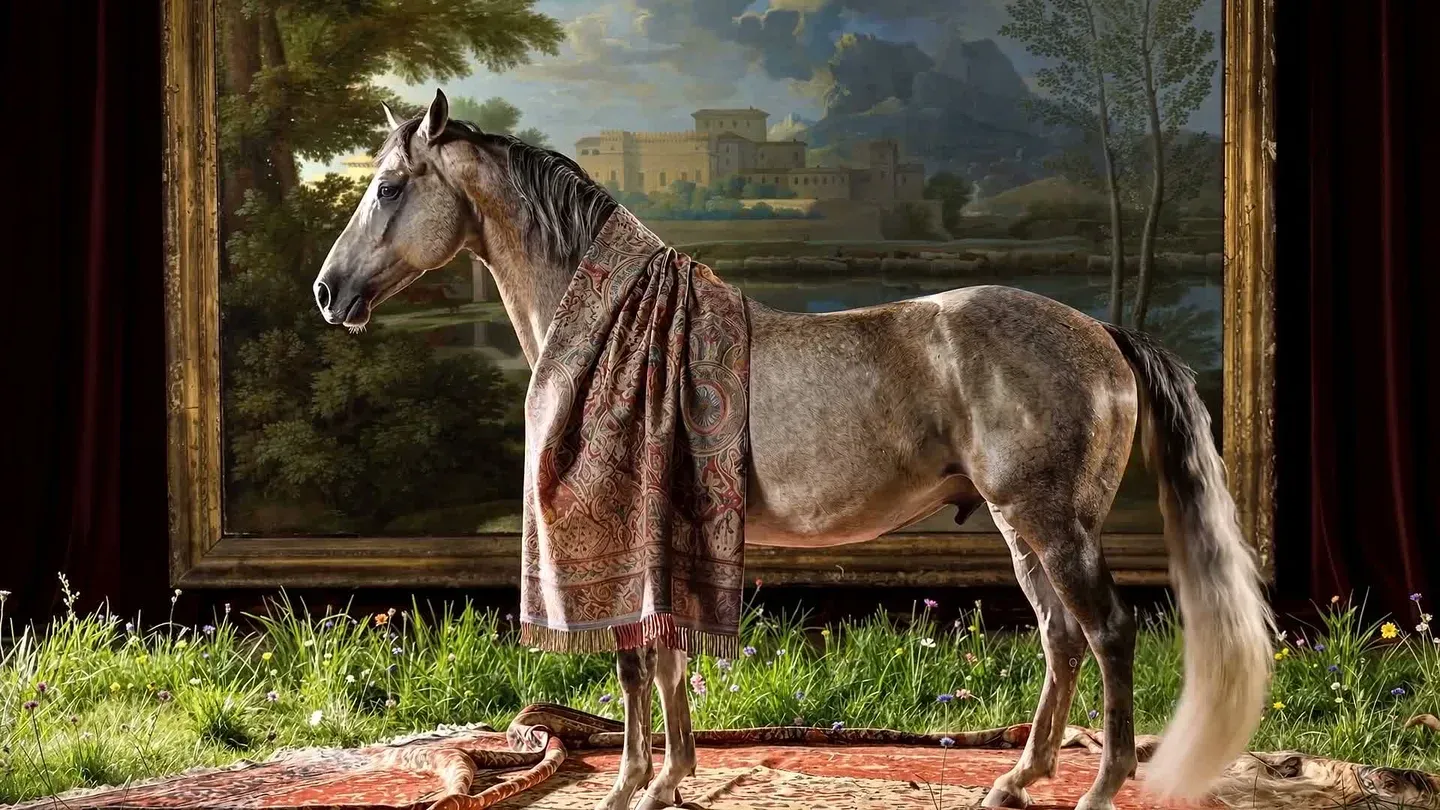
The portrait as a deed of title
Stubbs earned his horses by dissecting them. Eighteen months in a Lincolnshire barn, layer by layer, published in 1766 as The Anatomy of the Horse. Then he painted for the Newmarket racing aristocracy — Rockingham, Grosvenor, Richmond — and those commissions were documents. A painting of a horse and its rider verified land, livestock and lineage.
Arthur Boyd once warned me about the same thing, in a Shoalhaven paddock rather than a Newmarket one: be careful of painting a landscape, because in some way painting it is owning it. He said it lightly. I have been carrying it around for thirty years. He taught me most of what I know about brushes, and that one line about property.
In Whistlejacket, Stubbs took a royal equestrian pose and deleted the king. He put the horse in an empty room two hundred and sixty years ago, and the rider has stayed gone ever since. What has not gone is the survey: the architecture built to hold the animal, classify it and claim it. Taking the rider out does not touch any of that.
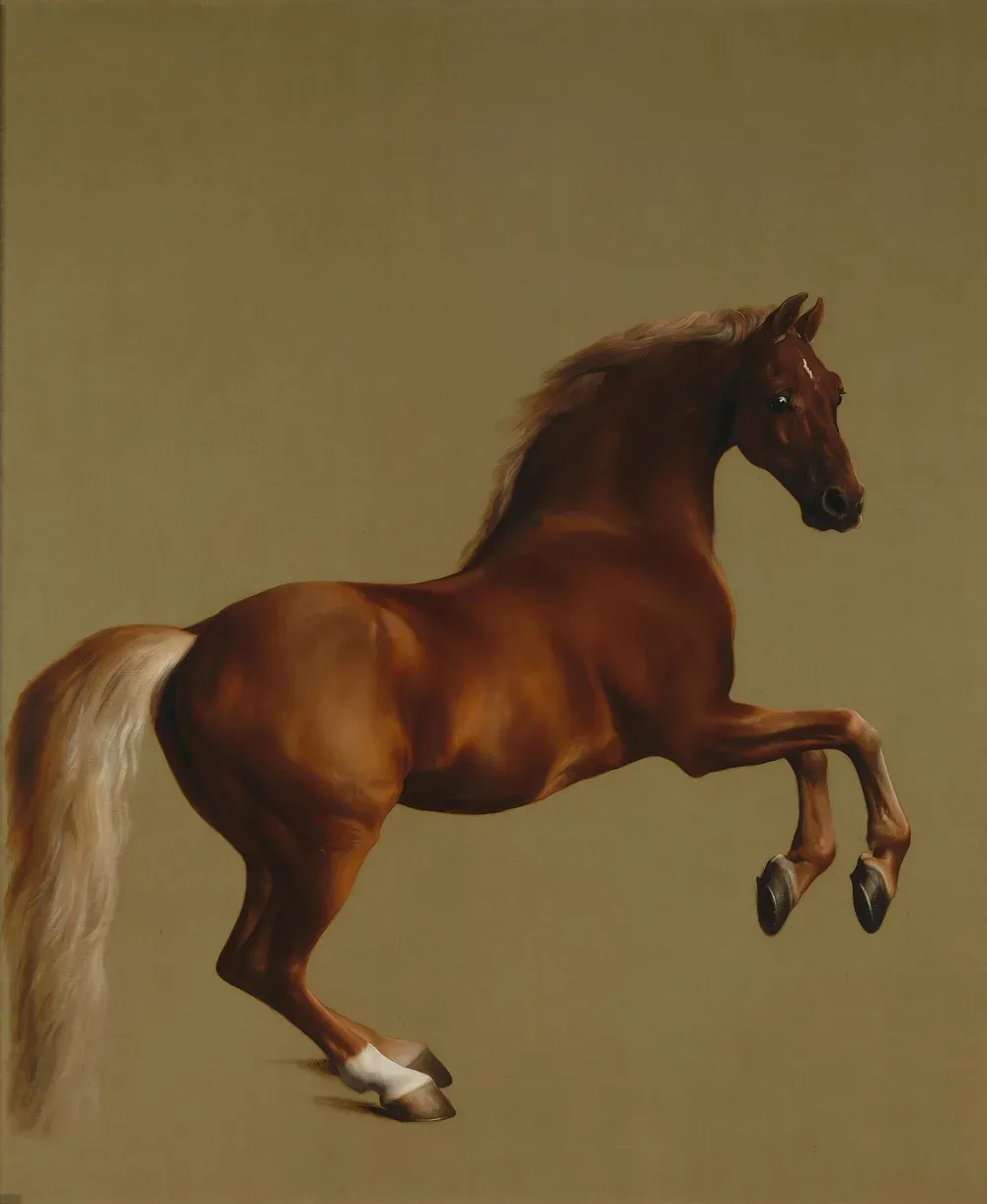
A court with nobody in it
The Patron, The Pretender, The Duchess, The Heir. Four dynastic portraits with no people in them.
Poussin used to drape wet linen over wire armatures to catch a specific fold and hold it still for a week. I drape silk and brocade over nothing at all, to do the same job: prove a body was here without needing the body in the frame. The sitters have gone and left their clothes behind. The mantle, the blue silk, the gold brocade, the ceremonial textile — each one hangs over a thoroughbred and covers the space where an aristocrat sat.
The horse wears the titles and the prices without noticing them. It is a living thing standing inside a ghost of authority.
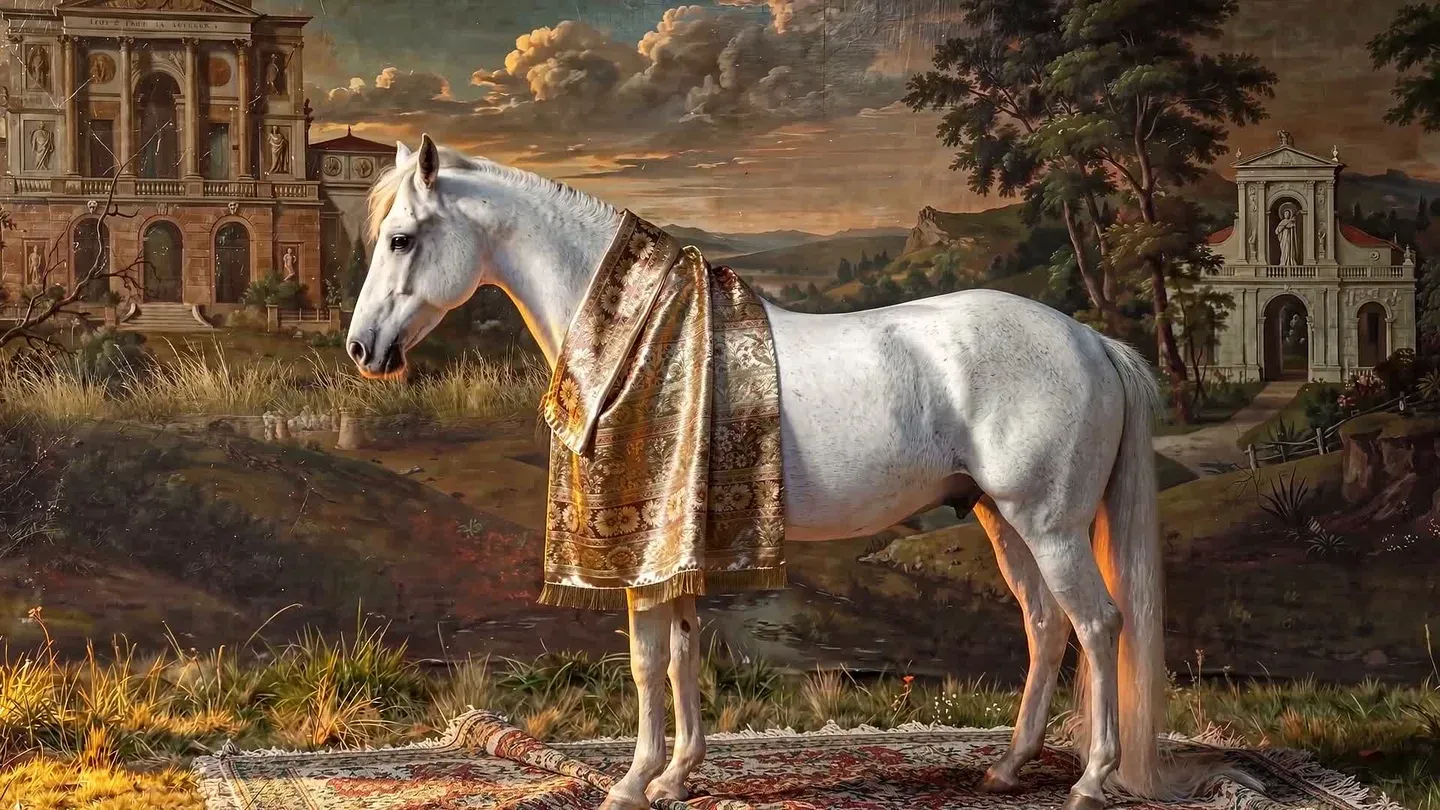
The stud book as a Baroque library
James Weatherby published the first volume of the General Stud Book in 1793, and after that a horse was either in the book or it was nothing. Ninety-five per cent of thoroughbred male lines run back to a single stallion, the Darley Arabian, brought out of Aleppo in 1704 — which makes every English thoroughbred a Syrian migrant story. Weatherbys binds the stud book still, a small edition every four years, like an artist’s book. The breed is a rare book with legs.
That closing happened while the great Baroque libraries were still being built and filled. The same instinct is at work in both: gather the world, shelve it, shut the door, and call what is inside complete. I have been painting the Strahov Library for years. The stud book is the same room with a different catalogue.
Where the enclosure fails
Then it stops working. In A View, On Loan the painted backdrop will not stay behind the horse. The landscape climbs onto its flank and keeps going. If you cannot draw a line between the property and the animal, you cannot hold either one.
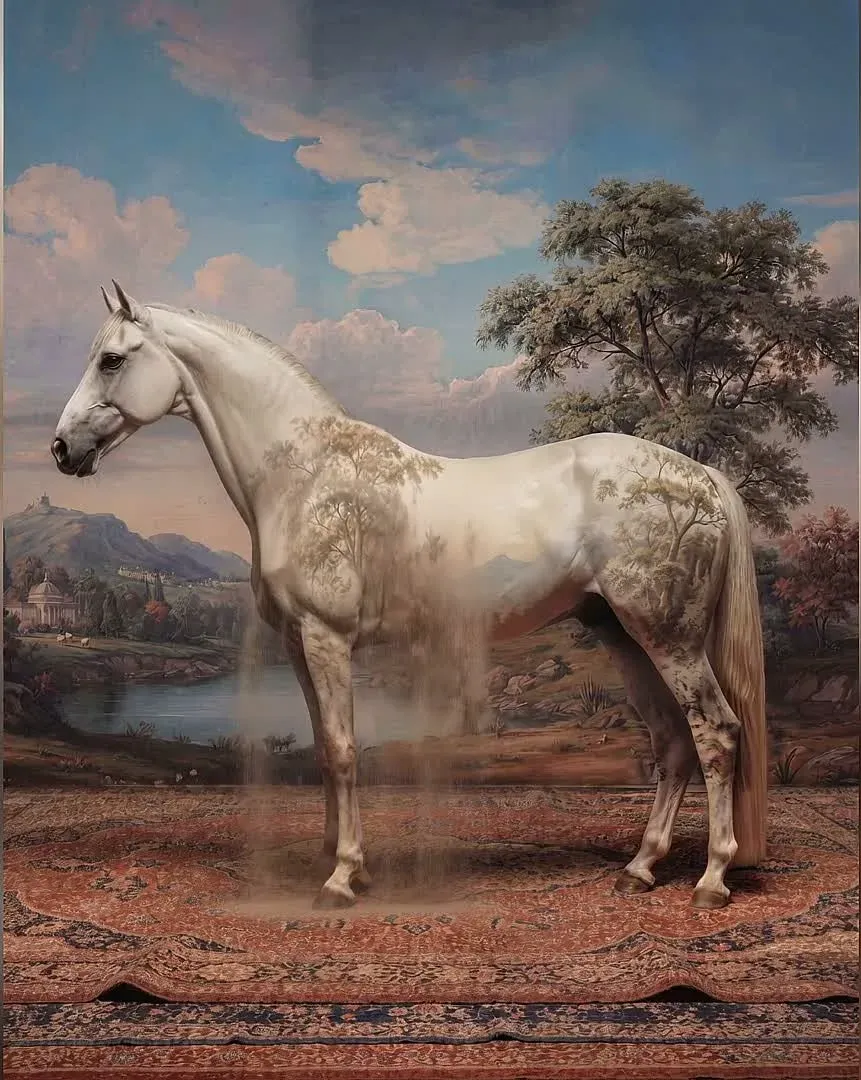
The suite ends in a gallery. Clouds after Lunch puts a thoroughbred on polished parquet in front of a monumental gold-framed landscape: Stubbs’s subtraction run backwards, everything left in. I have written about that reversal on its own.
The survey and the animal
Each of these paintings begins inside a box. Tintoretto built his out of wax, thread and a candle; Poussin scored a floor grid into his and cut one sight-hole at eye level. I rebuild the same device in three dimensions, stage a scanned horse inside it, set the light and the depth, and layer in fragments of my own canvases and landscapes out of museum archives. Only then does the oil begin.
Scanning a horse is closer to gesture drawing than to measurement. A horse never truly stands still. It shifts its weight, its muscles flicker, it breathes, and the capture is a set of fleeting coordinates stitched together before the posture changes. These point clouds do what the écorché and the anatomical drawing did for four centuries of equine painting: dissect mass, proportion and structural rhythm, then let me stage the animal in a theatre it never stood in.
What the scan cannot do is hold the animal. That gap, between the measured surface and the living thing, is what the paintings are about. It is not new to me either. For a decade my digital work has taken scientific instruments as studio tools. Ghost Trees was built from LiDAR surveys of endangered Australian forests, made with the sound artist Gary Sinclair from data gathered by Dr Kim Calders at TERN research sites, and shown across 120 channels at The Lume in Melbourne, at the National Film and Sound Archive, and at the Detroit Institute of Arts.
The forests and the horses are the same enquiry. A survey measures a living thing. The living thing is not in the measurement.
On Loan is six new works for London Art Fair 2027, in the Encounters section, with Art & Horse Racing Gallery under Ilka Gansera-Lévêque — a gallery that works from Newmarket, where Ilka trains racehorses a short walk from Palace House and its sporting-art collection. Same ground Stubbs worked, two hundred and sixty years apart. Business Design Centre, London, 19–24 January 2027.