The Museum's Last Diorama
Stubbs painted Whistlejacket in 1762, and it is still the most radical subtraction in sporting art. He had a commission for a champion stallion at heroic scale. He borrowed the pose from royal portraiture and deleted the rider. No bridle, no estate rolling away behind him. Just the rearing chestnut in an unpainted, luminous void, nearly three metres of him.
Erase the world around a horse and you give it a kind of freedom.
Stubbs emptied the room. In Clouds after Lunch I wanted to furnish it.
I brought the horse back indoors, into a museum. He stands on polished parquet, hooves on a crumpled Persian rug, in front of a large gold-framed landscape.
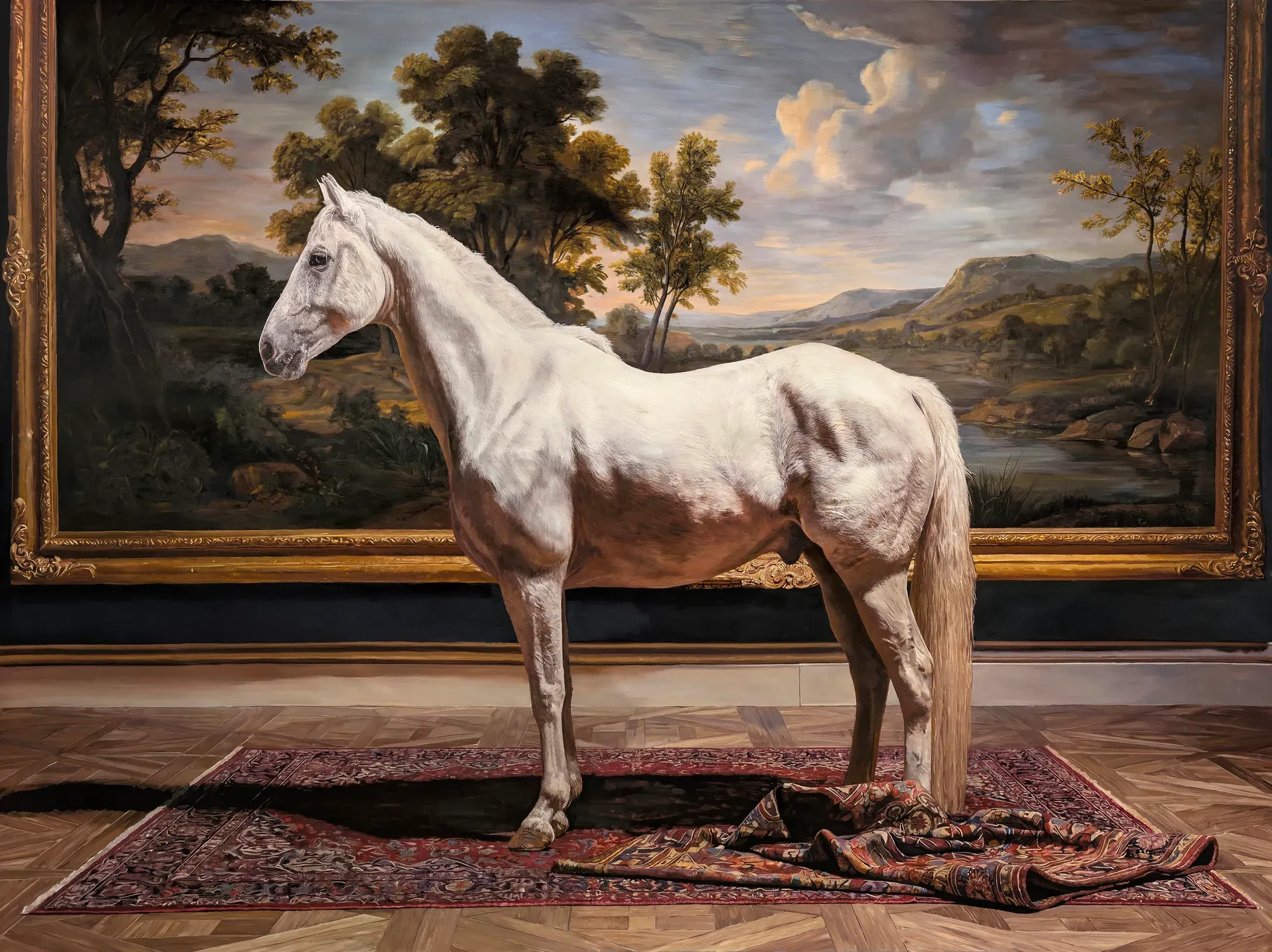
Claiming the horizon
Stubbs arrived at something close to a minimalist void two centuries before minimalism. I wanted the opposite — the museum’s last diorama.
The landscape behind him is our long habit of surveying and claiming nature. You frame a horizon so you can hang it on a wall and own it. The animal stands outside the frame.
Neither painting has a person in it. Stubbs got his freedom by taking things away. I wanted to see whether the horse could hold his own with everything left in.
On loan
He can. Gilt frame, parquet, the whole gallery — none of it registers. He knows nothing of his pedigree or his market value, and nothing of the architecture we have built around both.
The frame on the wall is an attempt to own something for good. The horse in front of it is a reminder that nature is only ever on loan.